Past Present Polarity
An Assignment for Arizona State University’s Course ENG 319
It started as a niggling feeling at the backside of my mind as I planned for the trip of a lifetime.
My husband, James, and I were looking forward to two weeks in Bavaria – I swore I was not going to show up underprepared. I had researched the weather and etiquette. I had planned the locations and travel solutions for the trip. I had not learned German completely but from what I understood most locals could speak English and where they didn’t Google would be my friend. The planning was complete, so why did I feel so anxious? Well, more anxious than normal anyway…
My greatest concern was that we were going to be made out to be American. There was no way that we wouldn’t – I mean we are Americans. The problem was that Donald Trump was elected president the year prior and from all that I understood he was not well-liked in Germany. He had made enemies with Angela Merkel and in doing so made enemies of the people of Germany.
I am a bit of a history nerd. Not so much for the specific dates but rather for the intentions behind the actions. Looking down from the plane it was difficult to tell that this was the epicenter of the Nazi Party. The location that the horrendous acts of World War II were born. It was hard to believe that they would be the undoing of many innocent souls. It was very much in mind as the discussion prior to leaving was about the nature of the Nazi uprising, especially as it applied to our current political context back at home in the States.
Questions ran through my mind in waves of anxiety-driven curiosity.
How could a person not stand up for those that need it? Would they view me as a signal of their past? Would I be considered aligned with the politics that my country was so apt to proclaim and belittle others with?
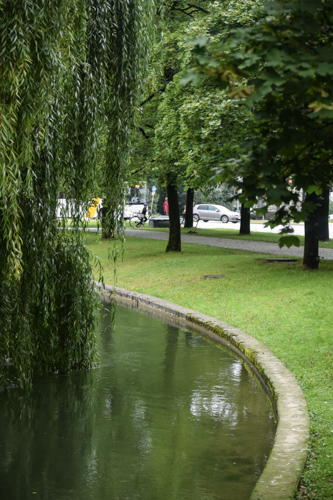
The weather began as dreary. The sky was a dark gray and the rain fell in large drops that splashed upon the puddles spraying water up to my knee. It did not take long for my pant legs to soak up the welcome and leave me with a slight chill as the breeze blew. This was nothing for my James and I as we are from the Pacific Northwest, although we would have expected July to be more sunshiny and warm. The skies were gray to match the asphalt of the walking overpass
that we were crossing, the industrial nature of the area we were staying contrasted with the trees and parks we spied as we crossed the street.
The rain trickled down off the leaves of the nearby deciduous tree. A drop landed on the back of my neck. It was letting up and there was life around the city streets. As we rounded the corner to reach the underground rail or the U-Bahn, we found ourselves weaving not around crowds of people but rather we crisscrossed between a myriad of parked bicycles. There they were piled in around the opening like a wildflower garden, their colors providing glimpses into their owner’s hearts. I found myself imagining the different lives that used the bicycles to wander the streets around me. The bike with the basket lined with artificial posies must be someone with a free heart, a contrast to the expectations that I had of the rigid German described to me online.
James and I rode a train into Füssen, a smaller town snuggled in close to the foot of the Allgäu Alps, near the Austrian border. Today, the bright sky only shined brighter the closer we were to the cliffs. Shooting off into the heavens several hang gliders shifted their weights effortlessly against the upward drafts. Their wings mirrored the floral window boxes in the town below. As we walked our feet clung haphazardly to the sidewalk’s cobbles, each one glistening in the sunshine.
The First Reich of Bavaria began in the 9th century with the Roman Empire, within the kingdom an emperor was crowned. Finely handcrafted Bayern gold hangs as tassels off the pillow of the crown symbolizing the wealth of the kingdom. The castles stand tall as a reminder of their might
as an empire. All this wealth lasting until after the Thirty Years’ War when Emperor Franz II abdicated his throne.
The streets of Füssen provided a classical view of Bavarian history. Hohes Castle, a standing example of the times of the bishop-prince (ca. 1270-1505) allowed a glimpse of the lives of royalty claimed by the Roman imperial power. The circles of light from the crown glass windows let concentric rings of prismed light reflect off the gold ceilings and medieval arts inside. Pieces of history in gilded glory showed the power of the church and the beauty of influence. The wealth of the empire continued into the Benedictine monastery turned Baroque church nearby.
The museum staff of St. Mang Abbey had selected a playlist of Benedictine chants to bounce along the long hallways. The sounds bringing the dead voices back into the hallowed halls of learning and prayer. A library designed to open on a classroom a floor below provided the monks with possible clarity of the meaning of life. The ceilings again, gilt in gold, featured murals and frescos of biblical and canonical scenes, the colors muted with time but none the less impressive. An image of Mary graced a wall in the original St. Anna’s Chapel (ca. 1600), the tears of paint looking like fresh rivulets staining her nearly flawless face. Her eyes staring unblinkingly toward the nave. As I looked deeper into her eyes, I felt a moment of introspection. The depth of the beauty of the artist’s interpretation almost overshadowed Mary’s grief but his attention to the lackluster of her eyes gave the understanding of the complete and utter distraught she was undergoing as she realized that her son was dead.
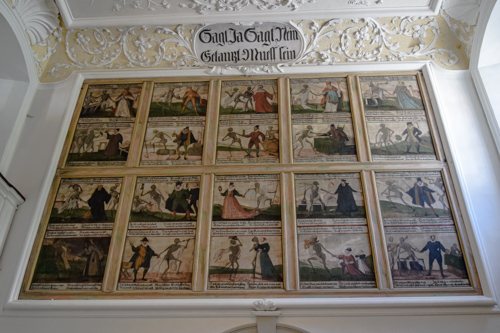
Inside the nave over the entrance hang twenty scenes painted on wooden panels. Twenty moments of the macabre, death dancing, showing the eventual demise of all who are precious.
An example of the fragility of life in a time where the plague was likely to bring you to your end. Füssen’s Danse Macabre (or The Dance of Death) is an example of the hardships that the German people worked through to become who they are today. The most striking image may have been the painter’s own
untimely dance performance. The sculpted tempura brush strokes counting the final beats of the timely dance of death.
“Says Yes Says No, being danced must be”
– Danse Macabre’s Motto
The opulence of the crown and the church providing an example of separation of wealth and power that I as an American would never understand. Or maybe I would, in the United States the wage gap is only creating a larger separation of the haves and the have nots. The ‘have-nots’ expecting the ‘haves’ to make the decisions for the betterment of all, while the ‘haves’ are not always looking out for the benefit of the many.
Weltenberg Abbey was just ahead, the walk from the parking lot – just slightly uphill – made the time to pass the distance slow going but that made the anticipation all the better. The path follows the Danube river on the left and a cliff-face of sandstone on the other and the asphalted driveway is sparsely sprinkled with moments of history. The most notable a plaque in memory of three soldiers of the US Army who had lost their lives in a training accident during the Cold War. It was a chilling reminder that Germany and America had a history and these souls had joined a long line of Americans that gave their lives on German soil.
The quiet of the river walk turned to a quiet of reverence and murmuring of festivity. At the end of the path stood a wall built into the cliffside, the pink paint a striking brilliance against the gray of the rock. Inside this wall is an arch that took us into the Kloster Weltenberg. The brilliance of the sun shone off the stonework as I was instantly taken back to the early 19th century. The abbey itself had been located here from its founding in 617, but the latest upgrade was made in 1842. The river noise was hushed as I entered the courtyard and was enveloped by the smells of the German food being served in the beer garden.
The walls of the courtyard stretched around the abbey like a strong hug, the white of the painted brick and stucco shone the reflection of the midday sun. The umbrellas of the beer garden flashed the logo ‘Weltenburger Kloster’ reminding the visitor of the location that the beer was fermented and prepared.
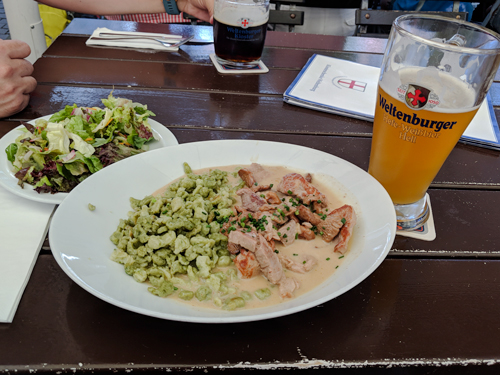
We sat to eat at a long table filled with other customers already enjoying their midday meals. The smell was wafting through the tent, rich stocks and gravies fought gallantly with the bright smells of the wheat in the dumplings and the spätzle. I ordered the special which to pair with the richness already in the air came with freshly harvested chanterelles and gravy ladled lovingly over some tender pork. The whole dish melted in my mouth as I tried to pick out the individual flavors. The star of the meal though was a light refreshing Weltenberg beer. The bright flavor of the beer as a counterpoint ran smoothly over my tongue as I washed down another bite of tender spätzle. James and I were not surprised that this abbey was able to produce a great beer, it was one of the reasons we went out of our way to taste it. The abbey has the reckoned title of the oldest monastic brewery in the world, having been in operation beginning in 1050.
We wandered away for a walk to help digest the meal and to take in the beauty of the site. The trees hung their long branches over the walls of the courtyard beaconing us up toward a pathway beside the church. A wedding being held in the sanctuary of the chapel created a silent barrier that James and I were unwilling to cross. Instead, we continued up a prayer path into a large meadow. As we reached the top of the hill the first bell chimed into the valley, it sounded poetic against the hushed grass.
Kaiser Wilhelm I created a new Second Reich when he was crowned over a unified Germany. Prussia and Bavaria stood as one under a new empire. This Kaiser, unlike the Emperors of the past, was from the north leaving the Bavarians under a different type of leadership. Nonetheless, the wealth flowed through the kingdom creating a mass of pride in the lives of the people. They
had a leader that they could follow and trust to lead the kingdom into the new century and beyond. That is until the First World War, the war to end all wars, saw Wilhelm II abdicate on November 9th, 1919.
The influences of the First and Second Reichs on the country are steadfast and culturally engrained. I was dumbfounded more than once by the lavishness of the silk and gold walls and the velvet draped across windows. The food was dressed in the richness of the past, moments of history covered with a gravy blanket giving my taste buds the expectation of the future. It is no surprise that they welcomed the possibility of a third.
The Third Reich began in 1933. With it, the Nazi propaganda machine brought about Nuremberg’s Dokumentationszentrum Reichsparteitagsgelände (Documentation Center Nazi Party Rallying Grounds). This center is now a memorial to remember the atrocities of the Third Reich, a place to not forget what pulled a nation to become savage. Nuremberg is a city defined by the old and new. Old Town holds the ghosts of the like of Albrecht Dürer and St. Sebaldus, patron saint of Nuremberg – whose shrine is supported by an army of snails. The new holds the ghosts of those tried at the Nuremberg trials, a history lesson that Germans remember as the way to never repeat.
James and I walked up the ramp towards the heart of the center of the Nazi Party. I had come mostly out of morbid curiosity and as a reminder of what humanity can so easily become. Our steps took us through the main entrance; a cantilevered glass ceiling blocked the sun from half of the ramp that seemed to take an eerily long time to walk. Inside the center, the brick and exposed steel felt industrial and hard in comparison to the castles and abbeys in the south. The voices of the ghosts echoed through the digital audio guide that I held to my ear.
I neared the exhibit called “Fascination and Terror”, the history of the rise of the Third Reich and Hitler. On the walls, in alcoves, and within displays listed the steps to the rise of one of the most feared and hated parties ever to exist. The stories droned into my ear, each numbered artifact coincided with an audio recording speaking matter-of-factly about how each step of Hitler’s life gave rise to his ego and power.
A copy of Mien Kampf sat under a plane of glass as a reminder of the ‘fascination’ that took hold of the people of Bavaria. Not a few steps later an image is printed so that the people are life-size moments of the past. Every moment of the museum took me closer to the inevitable.
It began simply, as a reaction to the economic downturn of Germany after many years of prosperity. The people of Bavaria became jaded by the lackluster of the democracy and were all too ready to find a replacement for the now gone monarchy. This is the moment that created an opportunity for Hitler. Within the halls of the center, the stories echoed like the Benedictine chants, memories of a time long gone. The ghosts of the images reminded me of the horror that the Nazi party allowed.
The walls of stone, brick, and metal crossbeams had housed a nation who were unaware of the fate that they had voted into leadership. They missed the moments of time as their liberties and freedoms were stripped with the final solutions designed by the regime they had elected into power. From a window looking down on the parade route, the voice of Hitler came over a speaker. His voice echoed along the halls in melancholy chagrin as a tyrant and a liar. All the same, I saw ghosts in that field of fit young men and women who only desired a better life.
At that moment I turned to see James walk up, “This isn’t easy, is it? Makes it all a bit too real.” With the barest of a tear in his eye, he could only choke out a “Yeah.”
We walked on in silence.



 3 Boys and a Mom